AI-Powered Multi-Agent Hospitality System (Saas)
A coordinated AI ecosystem of guest service, concierge, operational, and marketing agents that automates routine tasks, enhances guest experiences, and provides actionable insights for staff, all while preserving human oversight and control.
Client
Into AI customers
Service
AI Product Strategy & Ownership
Date
April 2024
Project Overview
Hospitality teams often face challenges managing guest experiences, operations, and marketing simultaneously. This project focused on designing a multi-agent AI system to handle diverse hospitality tasks—guest services, concierge support, operations, and marketing—while integrating with property management and smart automation systems.
The objective was to build an AI ecosystem that automates routine tasks, enhances guest satisfaction, and provides actionable insights for staff, all while maintaining human oversight.
Problem Statement
Hospitality workflows faced multiple challenges:
Staff spend excessive time on repetitive guest interactions, operational tasks, and marketing follow-ups.
Guest communications are fragmented across multiple channels (SMS, WhatsApp, email, in-app messages).
Operational data (room status, bookings, maintenance requests) is siloed across PMS, IoT devices, and other tools.
Marketing campaigns lack personalization and rely on manual segmentation.
Fully automated solutions often lack context, trust, and explainability.
A coordinated AI solution was needed to augment staff across multiple functions, rather than replace them, while ensuring consistency and reliability.
Solution
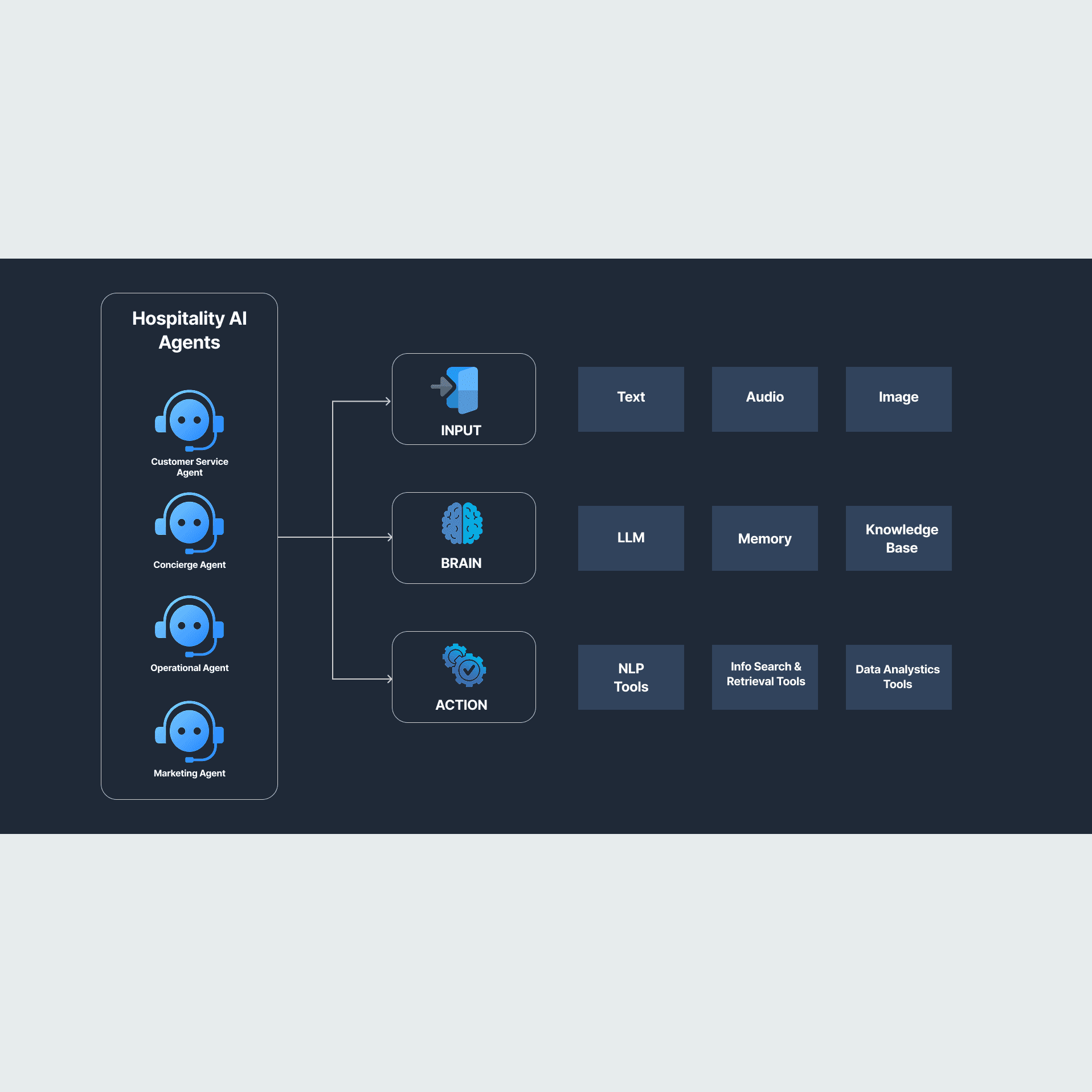
I designed and implemented a multi-agent AI system consisting of:
Guest Service Agent: Handles inquiries, check-in/out support, and routine guest requests.
Concierge Agent: Provides personalized recommendations, local information, and activity booking support.
Operational Agent: Automates PMS updates, room assignments, housekeeping notifications, and IoT device control.
Marketing Agent: Manages personalized guest communication, upselling, and post-stay follow-ups.
Each agent is orchestrated through LangGraph, allowing agents to communicate, coordinate actions, and escalate complex decisions to staff when needed. Human-in-the-loop oversight ensures trust and prevents errors.
System Architecture & Approach
The system was built as an automated, multi-agent workflow:
Input Capture: Multi-channel messages and operational events ingested in real time.
LLM-Based Reasoning: Each agent interprets tasks, scores priorities, and determines actions.
Inter-Agent Coordination: LangGraph orchestrates interactions between agents for complex workflows.
Action Execution: Agents update PMS, IoT devices, marketing platforms, or provide recommendations to staff.
Staff Oversight & Feedback: Critical decisions are reviewed by staff; outcomes are logged for continuous learning.
This design ensures efficiency, consistency, and adaptability across all hospitality functions.
Key Responsibilities
Designed the multi-agent architecture for guest services, operations, and marketing.
Built pipelines for multi-channel message processing and real-time operational data handling.
Defined reasoning logic, scoring, and escalation rules for each agent.
Implemented agent orchestration with LangGraph to enable coordination and workflow automation.
Developed human-in-the-loop validation for critical tasks and decisions.
Designed dashboards and reporting tools for monitoring agent performance and insights.
Defined roadmap for future enhancements (multi-language support, predictive guest behavior).
Technologies Used
LangGraph: Orchestration of multi-agent workflows and AI reasoning.
OpenAI / Gemini: Natural language understanding and decision-making.
Python: Processing, validation, and task automation logic.
Webhooks & APIs: Integration with PMS, IoT devices, and marketing platforms.
Multi-channel Messaging APIs: WhatsApp, SMS, email integration.
Challenges & Learnings
Coordinating multiple agents requires careful orchestration to prevent conflicting actions.
Guest requests vary widely; context-aware reasoning is essential for accuracy.
Human-in-the-loop oversight remains critical for trust and operational safety.
Multi-channel and multi-domain automation adds complexity but increases efficiency and consistency.
Hospitality AI succeeds when agents are explainable, adaptive, and fully aligned with staff workflows.
Outcome & Impact
Reduced staff workload across guest services, operations, and marketing.
Improved guest satisfaction through faster, more consistent, and personalized interactions.
Increased operational efficiency with automated PMS updates and IoT device management.
Delivered a scalable, modular foundation for AI-driven hospitality operations.
Enabled staff to focus on high-value tasks while agents handle repetitive or predictable work.