Multi-Agent AI SAAS Platform for education
A multi-agent AI SAAS platform designed to automate and orchestrate complex operational workflows across support and education systems. Specialized agents collaborate, escalate, and interact with operational tools to reduce manual work, ensure consistency, and act under controlled human oversight.
Client
Teameo.io
Service
AI System Design
Date
September 2023
Project Overview
Soria.ai is a multi-agent AI platform designed to automate and orchestrate complex operational workflows across education and support systems. The goal was not to build a single “smart chatbot,” but to create a network of specialized AI agents capable of collaborating, escalating, and integrating with real operational tools.
I led the product vision and delivery of the platform, focusing on reliability, control, and real-world usability across systems like Microsoft Teams, Freshdesk, and Teameo (SIS).
Problem Statement
Organizations were facing:
Fragmented workflows across chat, ticketing, and student information systems
Manual triage and repetitive support tasks
Single-agent bots that failed when conversations became complex
Lack of control, escalation, and accountability in AI-driven support
There was a clear need for an agentic system that could reason, collaborate, and act within defined boundaries.
Solution
I helped design and deliver a multi-agent AI architecture where each agent had a clear role, responsibility, and decision scope, and could:
Communicate with other agents
Decide when to act vs escalate
Interact directly with operational tools
Stay aligned with product and business rules
The platform behaves more like a digital operations team than a chatbot.
System Architecture & Approach
The platform was built around agent orchestration and controlled autonomy:
Specialized agents (triage, support, student info, escalation)
Defined communication patterns between agents
Rule-based and context-based escalation flows
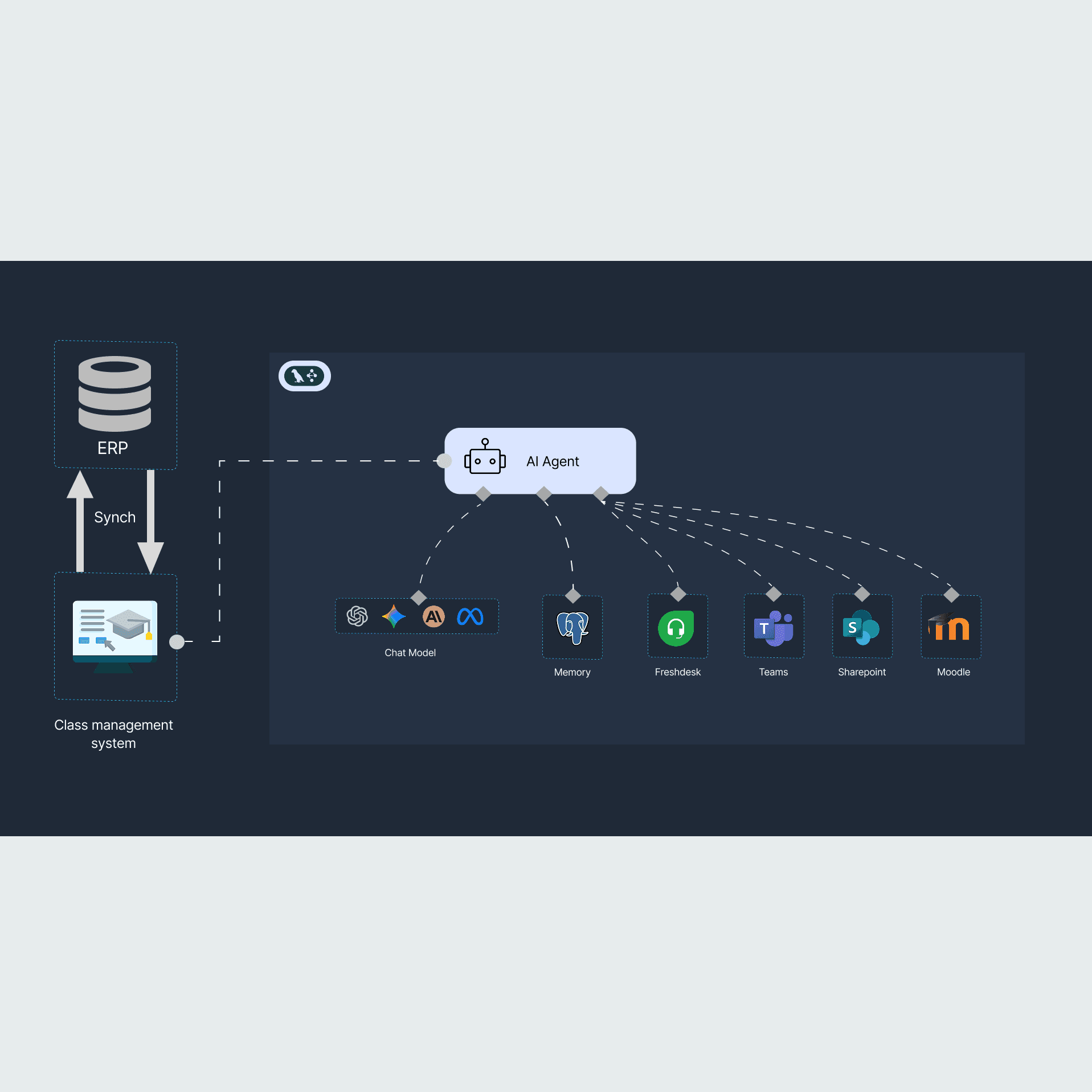
Tool-calling via APIs (Teams, Freshdesk, SIS)
Guardrails to ensure accuracy, consistency, and safety
Agents were designed to operate independently, but never in isolation.
Key Responsibilities
Led product vision and roadmap for the multi-agent platform
Defined agent roles, responsibilities, and collaboration patterns
Designed automation workflows for ticketing, student management, and support
Specified escalation logic between agents and to human operators
Managed backlog, wrote user stories and acceptance criteria
Validated AI-driven automations against real operational scenarios
Ensured controlled behavior, reliability, and accuracy of LLM agents in production
Tools & Technologies Used
LangChain / LangGraph for agent orchestration
Microsoft Teams API for conversational entry points
Freshdesk API for ticketing automation
SIS API for student data and workflows
Moodle API for course content data
Challenges & Learnings
Multi-agent systems fail fast without clear role boundaries
Escalation logic is as important as response quality
Reliability comes from process design, not model size
Human-in-the-loop remains essential for edge cases
This project reinforced that agentic AI is an operational discipline, not just an AI pattern.
Outcome & Impact
Automated large parts of support and student management workflows
Reduced manual triage and response time
Improved consistency and traceability of AI actions
Delivered a scalable foundation for future agents and use cases